

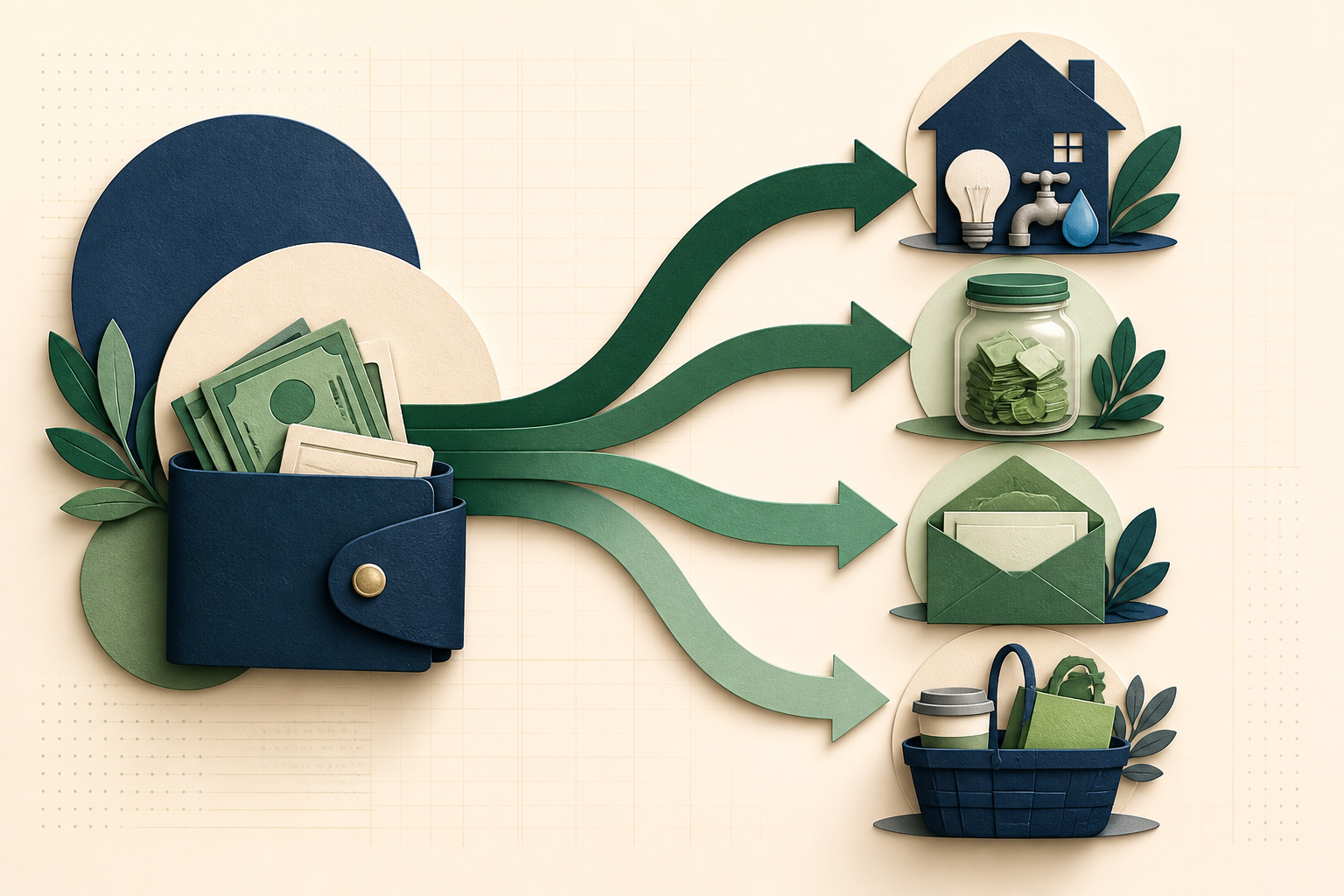
A budget that works is a decision about where take-home pay will go before the month gets noisy. Start with actual income, assign essential obligations, fund savings and extra debt payments, then decide what remains for flexible spending. The useful result is the monthly surplus—or the shortfall that must be fixed.
A list of expenses records the past. A working budget also sets priorities, makes irregular bills visible, and creates a feedback loop. If the numbers only work in a perfect month, the plan is not finished.
A practical order for each dollar
Build from cash flow, not a slogan
Use after-tax income that actually reaches your accounts. Separate fixed expenses, such as rent and insurance, from variable essentials, such as groceries and fuel. Savings and extra debt payments belong in the plan too; leaving them outside makes an apparently balanced budget misleading.
For irregular costs, estimate the annual amount and divide by 12. A $1,200 annual auto-insurance premium is a $100 monthly obligation even in months when no bill arrives. The same sinking-fund treatment works for gifts, repairs, annual subscriptions, medical deductibles, and travel already committed to.
Monthly cash-flow test
| Method | Core rule | Best use | Main limitation |
|---|---|---|---|
| Zero-based | Assign every dollar a job | Detailed control and irregular costs | Requires regular maintenance |
| 50/30/20 | Needs / wants / goals | Fast diagnostic starting point | Housing, care, and debt may make the split unrealistic |
| Pay yourself first | Automate goals, spend the remainder | Consistent saving with stable cash flow | Can hide overspending if essentials were not tested first |
Worked example
A $7,200 take-home household
The household assigns $4,550 to essentials, $1,200 to flexible spending, and $1,350 to retirement, an emergency fund, and extra debt. Total allocations are $7,100.
That leaves a $100 surplus, or 1.4% of income. It is small, but it is real—and can absorb modest variation without pretending groceries or transportation will never run high.
Where the $7,200 goes
| Bucket | Amount | Share of income |
|---|---|---|
| Needs | $4,550 | 63.2% |
| Wants | $1,200 | 16.7% |
| Savings & extra debt | $1,350 | 18.8% |
Fix a deficit without making the budget fictional
Start with the largest adjustable categories rather than cutting ten small pleasures that make the plan exhausting. Confirm that recurring charges still have value, shop or renegotiate large variable bills, and set a weekly guardrail for the categories most likely to drift. If the gap is structural—housing, care, transportation, or minimum payments—acknowledge that small spending cuts alone may not solve it.
In the example below, flexible spending is reduced by $250, turning a $150 shortfall into a $100 buffer. Savings and debt goals stay intact. The change is narrow enough to be tested for a month instead of assuming an extreme reset will last forever.
Before and after one targeted adjustment
| Plan | Essentials | Flexible | Goals | Balance |
|---|---|---|---|---|
| Before | $4,550 | $1,450 | $1,350 | -$150 |
| After | $4,550 | $1,200 | $1,350 | $100 |
Use the plan as a monthly operating system
- Build the first version from recent statements, not memory.
- Convert annual and seasonal costs to monthly sinking funds.
- Calculate once, then compare the submitted plan with what actually happened.
- Adjust one or two categories with the clearest payoff.
- Recalculate after a pay, housing, debt, or family change.
Plan for months that are not average
A monthly average can hide a timing problem. A household paid twice a month may have enough income in total but still face rent, childcare, and a credit-card payment before the second paycheck. Put major due dates beside pay dates and maintain a checking buffer for the gap. The annual budget and the cash calendar answer related but different questions.
Variable income needs an additional rule. Build the core budget on a conservative floor—such as reliable base pay or a cautious average of recent low months—then decide in advance how income above that floor will be divided. A household might send part to next month's buffer, part to taxes if they are not withheld, and part to the highest-priority goal. That prevents a strong commission month from silently becoming the new spending baseline.
Sinking funds keep predictable surprises out of the emergency category. If holiday travel, vehicle registration, school supplies, and appliance replacement are foreseeable, give each a monthly amount. The money can remain in one savings account if the household tracks the internal labels. The point is not to create dozens of accounts; it is to avoid spending dollars that already have a future job.
A useful monthly review takes fifteen minutes
Compare actual category totals with the submitted plan, but investigate only material differences. Ask whether the variance was timing, a one-off event, an incorrect estimate, or behavior that is likely to repeat. Timing may require no budget change. A recurring underestimate does. Preserve the history of prior months so one unusual grocery bill does not cause a permanent overcorrection.
When income rises, resist assigning the entire increase immediately. First confirm the net amount, then decide how much improves current life, strengthens the cash buffer, accelerates debt, or raises long-term saving. When income falls, protect housing, utilities, food, insurance, minimum payments, and essential transportation before reducing goals temporarily. A temporary lower contribution stated clearly is more realistic than a plan that depends on borrowing.